
Home »
For referring providers
Refer a gastroparesis patient
Dr. Hughes has placed more gastric stimulators than any other surgeon, and performs both operations laparoscopically as outpatient surgery. Here is when to refer, and what to send.

2,500 +
Gastric stimulators placed — more than any other surgeon, per Enterra Medical
2,000+
Laparoscopic pyloroplasties performed
~1 hour
Typical outpatient laparoscopic procedure time
ASC
Both operations can be performed at an ambulatory surgical center, lowering patient out-of-pocket cost
Career totals as of 2026. Individual results vary; no surgical outcome can be guaranteed.
Gastroparesis is a diagnostic challenge
Gastroparesis is frequently misunderstood and underdiagnosed. It has been estimated to afflict 1.8% of the community, while only 0.02% have been diagnosed.
The cardinal symptoms — nausea, vomiting, bloating, early satiety, postprandial fullness and upper abdominal pain — are often confused with biliary colic and gallbladder dyskinesia.
Weight loss is not a reliable criterion
Patients typically evolve to a carbohydrate-rich diet, as protein and fat empty poorly. This can produce a hyper-insulinemic state with fatty liver and weight gain rather than loss. Weight loss should not be a necessary part of the diagnostic criteria.
Upper abdominal pain can be a challenging part of the clinical picture. Gastric distension increases wall tension, decreases perfusion, and causes crampy upper abdominal pain. While narcotics should be avoided, their use should not preclude referral.
After obstruction is ruled out by UGI or EGD, a gastric emptying study is needed before referral. A 4-hour solid-phase study is the most informative and is what we would ask for ideally — but it is not a prerequisite, and in our experience most gastric emptying studies are sufficient to obtain insurance approval.
What we do and do not need
We do need a gastric emptying study. What we do not need is a perfect one.
- It does not have to be a full 4-hour solid-phase study. Whatever study the patient has had is a reasonable starting point. Please do not delay the referral to repeat it.
- Multiple studies, some normal and some delayed? No need to repeat. One delayed study is enough.
- The study did not show delay, but the symptoms fit? Still refer. This could be functional dyspepsia, and we frequently manage these patients exactly as we manage gastroparesis.
When should I refer a patient?
First-line therapy should include dietary modification, glucose control and, where possible, narcotic cessation.
Pharmacologic therapy includes prokinetic agents (metoclopramide, erythromycin, and/or domperidone), antiemetics (promethazine and/or ondansetron), and antacids (omeprazole, pantoprazole and others). These often fail and can be poorly tolerated, but they should be tried before referring for surgery.
A reasonable point to refer
- Obstruction ruled out by UGI or EGD
- A gastric emptying study has been done — it need not be a full 4-hour study, and it need not show delay, as long as the patient has symptoms and signs consistent with gastroparesis
- First-line and pharmacologic therapy have been tried
These are guidance rather than gatekeeping. If a patient's symptoms fit and you are unsure whether the work-up is complete, send them and we will sort it out.
In a study of 1,423 patients, only 4% rated themselves satisfied with available treatment. In a separate study, patients reported they would accept a median 13.4% risk of sudden death from a hypothetical medication if it could cure their symptoms.
Our approach: symptoms decide, not surgeon preference
The patient's symptoms define the management. Not our preference, and not the order we happen to be used to.
Most often that means pyloroplasty first. Consistent with published recommendations, Dr. Hughes generally starts there, since only about one third of patients go on to need gastric stimulation. Patients wait three months following pyloroplasty before proceeding to stimulation.
But not always. After careful evaluation, some patients are better served by gastric stimulation first. Where nausea and vomiting dominate without significant bloating, early satiety or upper abdominal pain, there is no stomach under pressure to decompress, and pyloroplasty is unlikely to address what is actually wrong. Those patients go straight to stimulation.
Gastric stimulation appears more effective against nausea, with or without vomiting, than against bloating, early satiety and pain — which is precisely why the presenting symptoms, rather than a fixed sequence, determine where we start.
Stimulators are placed laparoscopically as an outpatient procedure taking about an hour, with the generator programmed to its lowest settings. Patients are then seen in clinic every one to two months for adjustment. Having had the pyloroplasty first, the patient will likely achieve symptom control earlier and on lower settings. This will prolong battery life and reduce the number of operations needed.
Where the operations are performed
Both procedures can be done at an ambulatory surgical center rather than a hospital. That matters for any patient with out-of-pocket exposure — deductibles, coinsurance, or cash pay — because the procedures are significantly less expensive at an ASC. Infection rates are lower as well.
Pyloric intervention: how we think about G-POEM, Botox and pyloroplasty
We are asked about this often, so it is worth setting out plainly. The distinction that matters is not endoscopic versus laparoscopic, and it is certainly not a question of who does the better procedure. It is a question of what is actually obstructing the pylorus in the patient in front of you.
Pylorospasm and fibrotic pyloric stenosis look similar clinically and respond very differently to the same intervention.
What each operation does mechanically
Pyloromyotomy longitudinally divides hypertrophic muscle, which then separates. The mucosa remains intact. This is highly effective for infantile hypertrophic pyloric stenosis, where the problem is muscle and there is no fibrosis.
Pyloroplasty longitudinally divides all layers of the distal stomach, pylorus and duodenum, exposing the lumen. The two cut ends of the pylorus are held apart while the divided stomach is anastomosed to the divided duodenum. Stomach and duodenum fuse, so the two cut ends of the pylorus cannot scar back together. A properly performed pyloroplasty never needs to be repeated, and it is equally effective whether the obstruction is spasm or fibrosis.
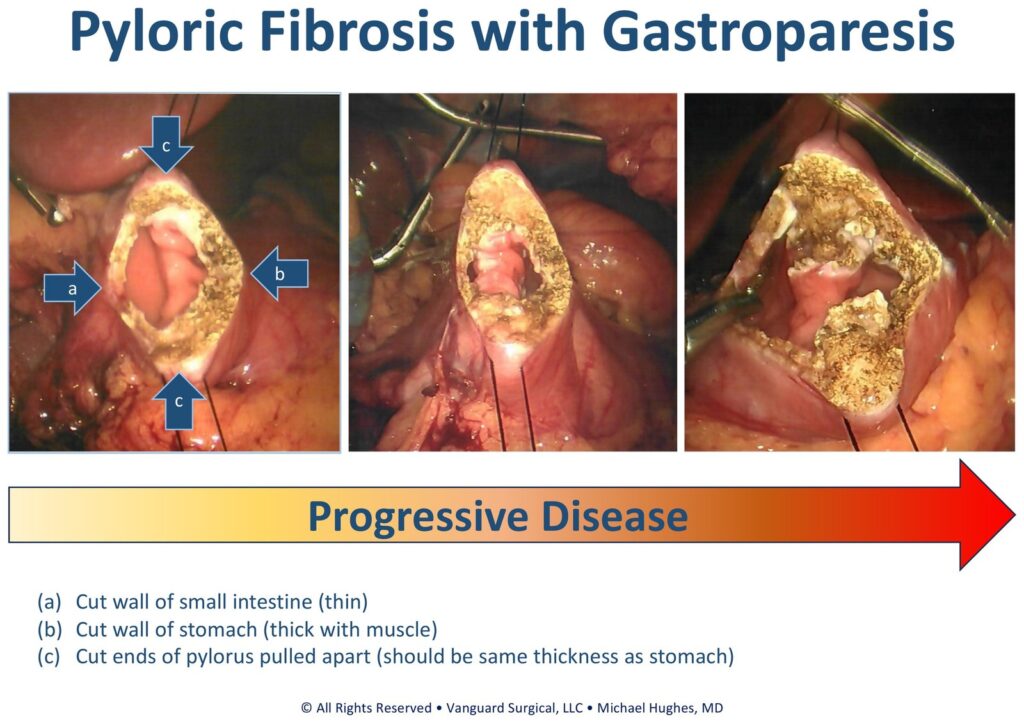
Progressive pyloric fibrosis, seen intraoperatively. The cut ends of the pylorus (c) should be the same thickness as the stomach wall (b). Where they are not, the muscle has been replaced by fibrous tissue — and that tissue does not respond to anything that relieves spasm.
G-POEM is a pyloromyotomy, not a pyloroplasty. That is the whole of the difference. It is most effective in the patients whose pylorus is in spasm — which is why response to Botox predicts response to G-POEM, since Botox relieves pylorospasm and does nothing for established fibrosis.
A caution on repeated Botox injection
Injecting Botox into the pylorus can create an inflammatory reaction, and that inflammation can convert pylorospasm into fibrotic hypertrophic pyloric stenosis. Repeated injections are therefore unlikely to help, and may make the underlying problem less reversible.
Prior G-POEM burns no bridges
This is the point we would most like referring gastroenterologists to hear.
If a patient does not respond to G-POEM, or their symptoms recur afterwards, pyloroplasty remains effective, and in our hands is no more technically difficult after a G-POEM. Nothing is lost by having tried it first.
We will not second-guess your management
Please do not hesitate to refer a patient whose G-POEM you performed. We will never be critical of how a patient was managed before they reached us. Choosing an endoscopic option first is a reasonable decision, and in several situations it is the right one.
When we send patients the other way
For the occasional patient at too high a risk for surgery, we will refer to one of our gastroenterology colleagues for G-POEM evaluation. Endoscopic intervention is the better answer for that patient, and we would rather they have it than nothing.
Access matters too. Most surgeons have not been trained to perform pyloroplasty laparoscopically, and fewer still offer it as an outpatient procedure. Exactly how few is impossible to say: the operation has no billing code of its own, so it cannot be counted in any national database. In a region where no surgeon offers outpatient laparoscopic pyloroplasty, G-POEM may well be the best initial strategy if pyloric intervention is indicated.
We do not offer G-POEM here — not because it lacks a role, but because pyloroplasty is available in this practice laparoscopically, as an outpatient procedure, in an ambulatory surgical center.
On complications
Leak is the major complication of both procedures. In more than 2,000 pyloroplasties there have been eight leaks — under half of one percent — which compares favorably with published leak rates for pyloric intervention generally. We have not had a pyloroplasty fail because of restenosis.
Complication figures are Dr. Hughes's own series as of 2026. Individual results vary, and no surgical outcome can be guaranteed.
Why trust Dr. Hughes?
During a decade at the University of Louisville as an abdominal transplant surgeon and Director of Pancreas Transplantation, Dr. Hughes placed more than 1,000 gastric stimulators — Enterra I, and more recently Enterra II. His initial interest was managing the severe gastroparesis affecting brittle diabetics undergoing pancreas transplantation. Demand grew until he focused on gastroparesis and started a practice built around these patients. He has now placed more than 2,500.
Having placed more gastric stimulators than any other surgeon, he found the device effective against nausea and vomiting but less so against bloating, early satiety and pain. Patients would often have the stimulator turned up so high that the generator reached end of service and required replacement in under a year.
He began performing pyloroplasty on those requiring frequent replacements, and found the stimulator was often effective at much lower settings. Equally significant, pyloroplasty was more effective against bloating, early satiety and pain. Some patients no longer needed the stimulator at all.
What colleagues say
“I have been practicing Gastroenterology for 25 years. For the last 2–3 years I have been sending patients to Dr. Michael Hughes for laparoscopic pyloroplasty and gastric stimulator as surgical treatment for gastroparesis. The patients have been very pleased with their care and I have been very pleased with the results. I highly recommend Dr. Hughes.”
Dr. Matthew Miller — Gastroenterology, Mt. Sterling, KY
“Dr. Mike Hughes has a fantastic practice that I would recommend to anyone. I have referred many patients from my practice in Ashland, KY with wonderful outcomes. Patients gain a greater quality of life from life-changing surgical procedures. Dr. Hughes personally updates me on my patient's status and always goes the extra mile.”
Ashlee Eichenlaub, APRN — King's Daughters Health, Gastroenterology, Ashland, KY
The process
How to refer
Submit a digital referral, or download the form and fax it to (844) 812-0089. Your staff can also call the office on (502) 912-8300 and we will fax the form to you.
What to send with a referral
- Clinic notes
- UGI series or EGD report
- Gastric emptying study — required; 4-hour solid-phase preferred, but any study is a start
- Your cell number, if you would like a call
How we communicate with you
We get patients in quickly and answer all phone calls within 24 hours.
After the operation
If you share your cell number with us, Dr. Hughes will call you directly after your patient's surgery — and again if any complication arises. Clinic notes and operative reports are faxed back to you either way.
Gastroparesis patients are the whole of this practice, and we would rather over-communicate than leave a referring provider wondering what happened to their patient.
The two operations
Pyloroplasty
Where we start for most patients. Opens the pylorus so the stomach can empty, and is more effective than stimulation against bloating, early satiety and pain.
Pyloroplasty
Where we start for most patients. Opens the pylorus so the stomach can empty, and is more effective than stimulation against bloating, early satiety and pain.
Ready to refer?
Submit a digital referral, or fax the form to (844) 812-0089 with clinic notes, the UGI or EGD report, and the gastric emptying study — whichever study the patient has had.
Vanguard Surgical, LLC · 2401 Terra Crossing Blvd, Suite 375, Louisville, KY 40245
Office (502) 912-8300
Referral fax (844) 812-0089